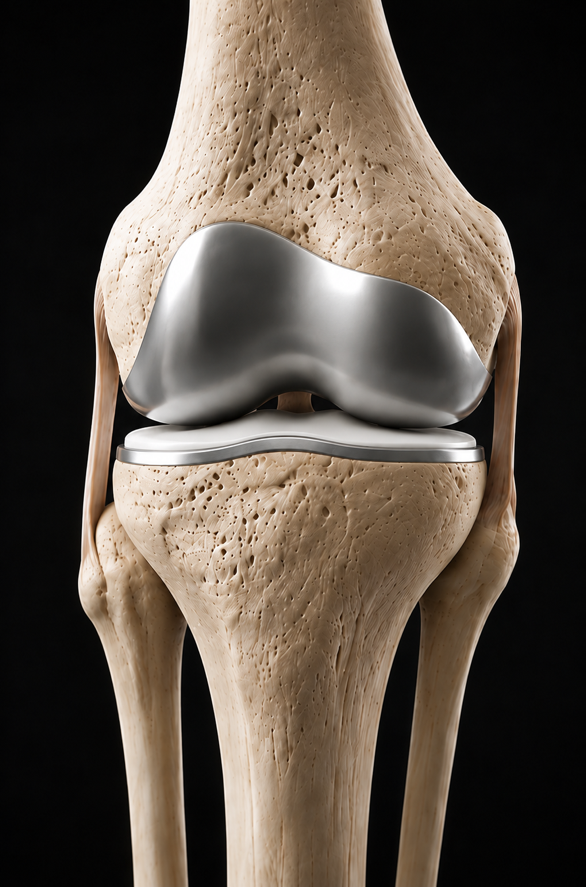
Your knee resurfaced to the shape, alignment and motion you were born with, not to a standard target.
Available now from every TrueKnee surgeon.
Resurfacing, not reshaping
Every knee replacement removes the worn cartilage and caps the ends of the bones with implants. What differs is where the implants are placed. A traditional replacement aims every knee at the same straight line. The TrueKnee technique puts your implants back at the angles and tilt your knee had before arthritis, measured from your own bone, so your ligaments and joint line stay where they have always been.
What every TrueKnee surgeon agrees to
The technique is written down, and every TrueKnee surgeon signs it: the femur is resurfaced to its own surface; the tibial cut is guided by the femoral cut, tibial landmarks, a stylus technique or robotics; the surgeon reaches the knee through a medial parapatellar, midvastus or subvastus approach; the implant is medially constrained, with the PCL retained or resected; and no soft-tissue releases are made. You can read the criteria exactly as surgeons agree to them.
Why it is done this way
The aim is a knee that feels like yours because it moves the way yours did. Published studies of this way of aligning a knee, called kinematic alignment, report equal or better function in the first years and no increase in revisions compared with the traditional straight target. They describe the approach in general; they do not predict your result.